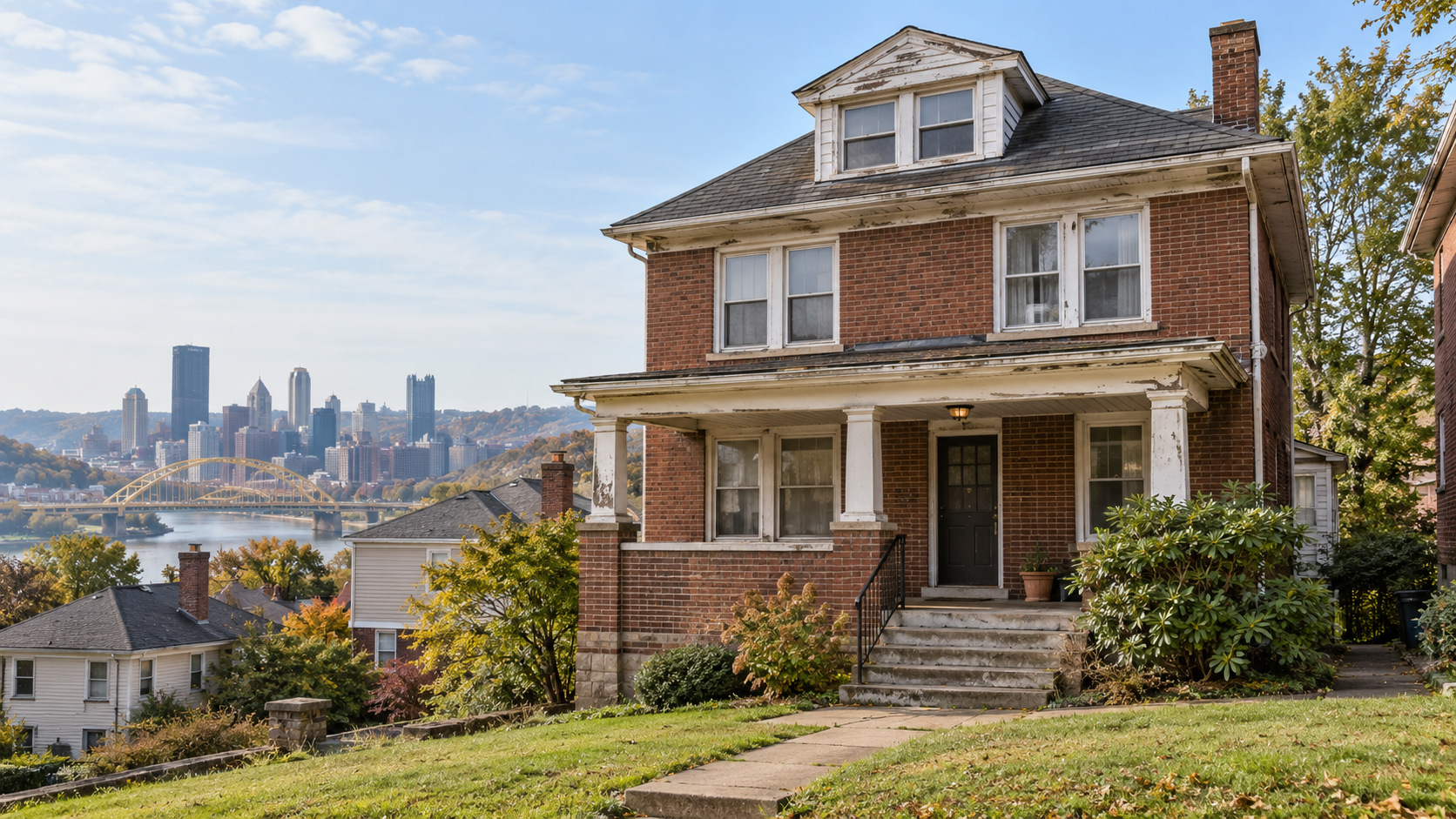
Selling a house “as-is” usually means putting the property on the market in its current condition instead of repairing or renovating it first. For many Pittsburgh homeowners, that can be a practical option when the house needs more work than they want to take on themselves.
That could mean an older roof, outdated electrical service, water damage, a worn kitchen, foundation concerns, deferred maintenance, or simply a property that has not been updated in a long time. It can also apply to inherited homes, vacant properties, and houses owned by someone who now lives outside the area.
The important point is that “as-is” describes the condition in which the property is being sold. It does not mean the seller can ignore Pennsylvania disclosure rules, title issues, municipal requirements, or the terms of the purchase agreement.
What does “as-is” actually mean?
In practical terms, an as-is sale tells the buyer that the seller does not plan to complete a list of repairs before closing. The buyer evaluates the property based on how it sits today and factors the expected work into the price.
That does not necessarily prevent inspections or due diligence. Depending on the contract, the buyer may still want to inspect the house, review the condition of major systems, check title, or confirm municipal issues before closing.
For a seller, the benefit is that the process may not require spending weeks or months managing repairs before the property can be sold.
Pennsylvania sellers still have disclosure obligations
This is one of the most important things to understand about an as-is sale in Pennsylvania.
For covered residential transactions, Pennsylvania’s Real Estate Seller Disclosure Law requires sellers to disclose known material defects before the buyer and seller enter into an agreement of transfer. The disclosure categories include items such as the roof, structure, plumbing, electrical systems, heating and cooling, water and sewage systems, hazardous substances, and certain legal issues affecting the property.
Selling as-is does not erase those obligations.
If you know the roof leaks, deciding not to replace it is one thing. Failing to disclose a known material issue is something else.
There are exceptions and transaction-specific rules, so legal questions should be directed to the appropriate Pennsylvania real estate professional or attorney.
What kinds of properties are commonly sold as-is?
As-is properties are not limited to abandoned houses or extreme fixer-uppers. In Pittsburgh, they can include homes that are perfectly livable but need enough work that the owner does not want to prepare them for a retail sale.
Common examples include houses with:
- major repair needs
- outdated kitchens or bathrooms
- an older roof or HVAC system
- plumbing or electrical issues
- foundation or structural concerns
- deferred maintenance
- vacancy
- inherited ownership
- code or municipal issues
- large amounts of personal property still inside
The decision is usually less about whether the property can be sold and more about how much work the owner wants to take on before selling it.
Three common ways to handle a house that needs work
A homeowner generally has more than one option.
Renovate first, then sell
If the house has strong resale potential and the owner has the money, time, and contractor access to manage the work, renovating before sale can make sense. A well-executed renovation may produce a higher sale price.
The tradeoff is that the owner takes on the renovation itself, including contractor risk, unexpected costs, taxes, insurance, utilities, financing expenses, and the time required to finish the project.
A higher sale price does not automatically mean a higher net result.
List the property in its current condition
A homeowner can also market a house as-is to the broader market. This may expose the property to more buyers than a direct investor sale, but condition can affect who is willing or able to buy, especially when significant repairs are involved.
Inspection negotiations, financing requirements, appraisal issues, and buyer expectations may still matter.
Sell directly to an investor
A renovation-focused investor evaluates the property based on its current condition and the economics of the project.
That usually means accounting for renovation costs, carrying expenses, financing, transaction costs, resale costs, contingency, risk, and the investor’s required return.
The advantage for the seller is not that those costs disappear. It is that the seller may not have to manage and fund the renovation personally.
Why an as-is offer is not the same as renovated retail value
This is where sellers sometimes compare two numbers that are not really comparable.
Suppose a fully renovated property nearby sells for $320,000. If your house needs $70,000 in renovation plus several months of carrying, financing, transaction, and resale costs, it would not make sense to compare an as-is investor offer directly with that $320,000 sale price.
A renovation buyer has to account for the cost of getting from the current condition to the finished condition.
A better comparison is between:
the realistic net amount you could receive by selling the property today
and
the realistic net amount you might receive after completing the renovation, carrying the property, and then selling it
That gives you a more useful basis for deciding what to do.
When repairing first may be the better choice
Repairing or renovating before sale may make sense when the property is already mostly market-ready and the remaining work is relatively manageable.
It may be worth considering if:
- the expected renovation cost is modest
- the house is in a strong retail location
- the owner has reliable contractors
- time is not a major issue
- the owner can comfortably fund the work
- maximizing the final sale price is the main priority
When an as-is sale may be more practical
Selling in the current condition may be worth comparing when:
- the property needs extensive work
- several major systems need replacement
- the owner does not want to fund a renovation
- the house has been sitting vacant
- the property was inherited
- the owner lives far away
- code issues exist
- carrying costs are adding up
- managing contractors is not something the owner wants to do
How Ben & Bash evaluates an as-is property
Ben & Bash Investments looks at the property as a real renovation project.
We review the neighborhood, comparable sales, current condition, likely renovation scope, resale potential, transaction expenses, holding period, financing costs, and risk before deciding what we can offer.
Our goal is to do the work before putting a number in front of the seller.
We are not interested in presenting an artificially high opening number simply to create room for repeated negotiations later. If new information comes up that materially changes the condition or renovation scope, the numbers may need to be reviewed, but we want the initial offer to reflect the property as accurately as possible based on what we know at the time.
How we handle different transaction structures
Ben & Bash evaluates each property individually. Some properties may be purchased by us directly for renovation or investment. If a different permitted transaction structure makes more sense for a particular property, we will explain that structure clearly before you are asked to proceed and handle the transaction in accordance with applicable Pennsylvania requirements.
What happens after you contact us?
The process normally starts with the property address and a few basic details.
From there, we may review public records and comparable sales, ask about the condition, look at photos, arrange access if necessary, and estimate the renovation. If the property fits what we are looking to buy, we can then discuss an offer.
Contacting us does not obligate you to sell.
Related guides
Frequently Asked Questions
Can I sell a house as-is in Pennsylvania?
Yes. A property can be sold in its current condition, subject to applicable disclosure, title, contract, and transaction requirements.
Does selling as-is mean I do not have to disclose problems?
No. Covered Pennsylvania sellers generally still need to disclose known material defects.
Do I have to clean the house out first?
Not necessarily for every direct sale. The condition of the house and any remaining contents should be discussed as part of the agreement.
Can I sell a house that needs a new roof?
Potentially, yes. Major repair items are part of what a renovation buyer evaluates.
Can I sell a house with structural problems?
Potentially, but the severity and cost need to be understood.
Will an investor pay the same price as a retail buyer for a renovated house?
Usually not, because the renovation buyer still has to account for repair, carrying, financing, resale, and risk costs.
Do I have to accept an offer?
No.
How quickly can an as-is sale close?
That depends on title, ownership, liens, due diligence, the property itself, and the parties’ agreed timeline.
Sources & Further Reading
- Pennsylvania General Assembly, Real Estate Seller Disclosure Law, 68 Pa.C.S. Chapter 73
- Pennsylvania State Real Estate Commission
https://www.legis.state.pa.us/WU01/LI/LI/CT/HTM/68/00.073..HTM
Have a Pittsburgh-area property you are considering selling?
Send us the address and a few details. We will review the property and let you know if it fits what we are looking for.
Tell us about the propertyThis article is general educational information and is not legal, tax, or financial advice. Transaction requirements can vary by property and situation.